

Lockheed Martin (LMT): Demand Is Real. Execution Is the Bet.

FOR Conservative investors who want a durable cash-flow business, a real moat, and a dividend that holds up through cycles.
NOT FOR anyone who needs a perfectly smooth chart or who pretends contractor execution risk does not exist.
HORIZON 6–18 months.
POSITION Start small.
DATA AS OF late January 2026.
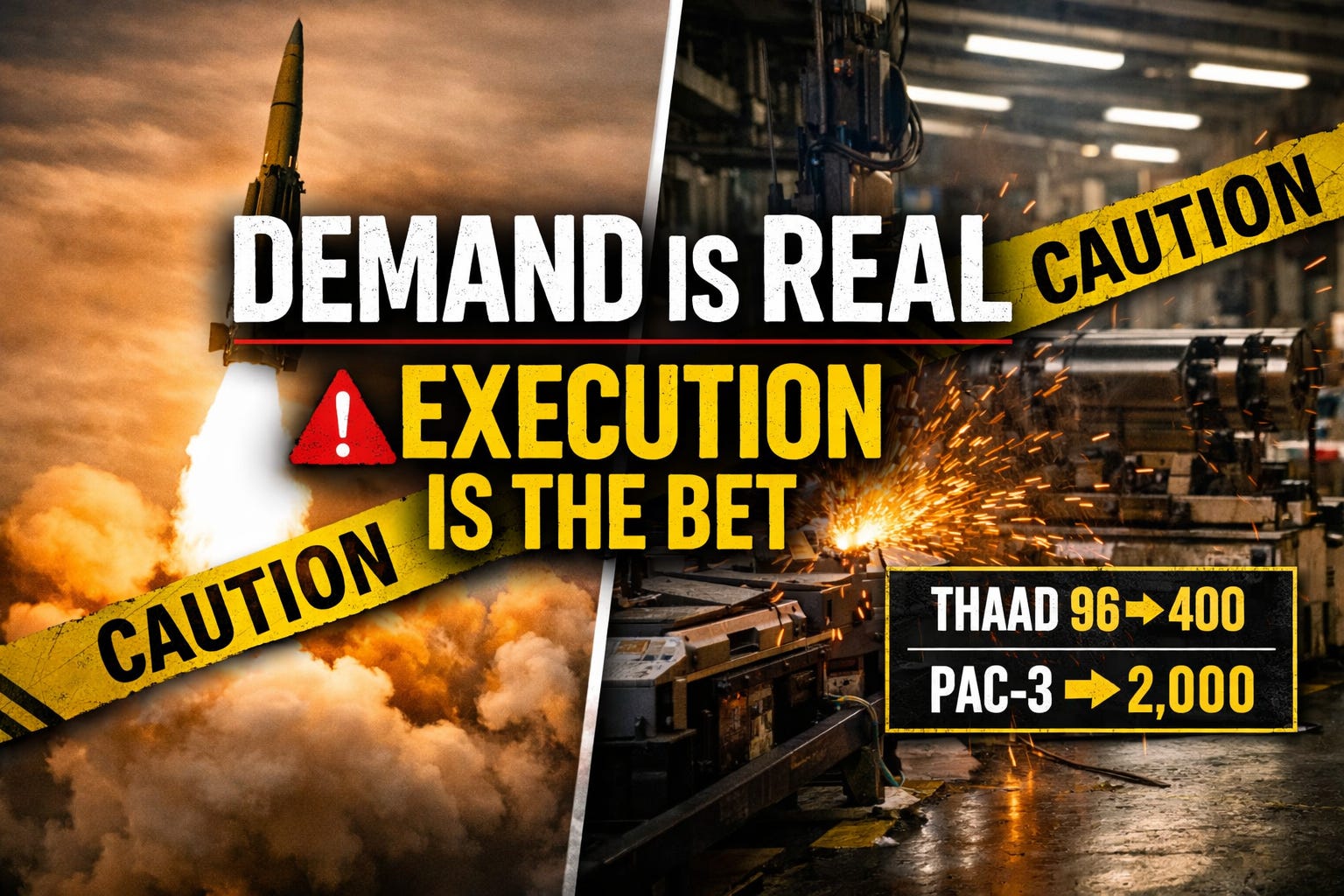
The world needs missiles, and Lockheed Martin sells exactly what the world is ordering: interceptors, F-35s, precision fires. The backlog sits at a record $194 billion, giving about 2.5 years of revenue visibility at the current run rate. Demand has never really been in doubt—especially with the recent seven-year framework agreement signed with the Department of Defense to quadruple THAAD interceptor production from 96 to 400 per year and accelerate PAC-3 toward 2,000 annually.
Demand is a given. Execution is everything.
Can management deliver without stepping on the same rake again? That’s the bet.
My stance is straightforward: start small and make them earn any increase. What changes my mind is measurable and boring proof.
Free cash flow needs to stay on track with the $6.5 billion to $6.8 billion outlook for 2026, capital expenditures must remain inside the $2.5 billion to $2.8 billion guide, segment operating margins need to recover toward the 10.5 to 11.2 percent implied by that outlook, and there can be no new surprise reach-forward losses tied to the production ramp. If those boxes get checked with clean quarters, the position grows. If management stumbles again, the position gets reduced or exited. No complicated reasoning required.
Why This Matters Now
The recent THAAD framework (building on the PAC-3 acceleration deal earlier this month) is the clearest “demand is real” signal yet. The Pentagon wants speed and scale amid global air-defense shortages. But rapid scaling means supplier bottlenecks, test-bay constraints, rework pileups, and fixed-price overruns that turn into hundred-million-dollar surprise charges—just like in 2025.
The market got the orders-are-real headline it wanted. Now the hard part: can Lockheed build and deliver without the program economics falling apart again?
Key Setup and Numbers (FY 2025 Actuals)
Lockheed operates as a prime contractor with four main engines: Aeronautics (F-35), Missiles and Fire Control (air/missile defense, precision fires), Rotary and Mission Systems (Sikorsky plus mission systems), and Space. The model is long-cycle production and sustainment, where certification, integration, and entrenched positions create the moat.
The core is healthy: 2025 sales $75.0 billion (up 6%), net earnings $5.0 billion, cash from operations $8.6 billion, free cash flow $6.9 billion (after pension contribution), backlog record $194 billion. Capital returns: $3.1 billion dividends + $3.0 billion buybacks (shares reduced to 229 million). At roughly $597 per share (market cap ~$139 billion), forward FCF yield on 2026 guidance is about 4.7–4.9%. Reasonable for a quality prime with real advantages—not cheap enough to ignore ramp risks.
2026 outlook: revenue $77.5 billion–$80.0 billion, free cash flow $6.5 billion–$6.8 billion, capex $2.5 billion–$2.8 billion (up ~60% for the ramp), implied segment margins 10.5–11.2% versus ~9.0% in 2025.
The Mismatch: Demand vs. Delivery
Headlines scream layup. Reality: the stock pays for clean cash delivery and stable margins—not hope, backlog size, or geopolitical noise. 2025 showed the pattern: $950 million classified Aeronautics reach-forward loss, plus $570 million and $95 million tied to helicopter programs in Rotary and Mission Systems. Those weren’t ancient history—they were last year, driven by the same aggressive timelines, fixed-price contracts, and complex integration now baked into the interceptor ramp.
The market is pricing in sustained demand, the record backlog, confidence in 2026 guidance, and missile-defense scaling as a tailwind.
What remains underweighted is the operational pain of “speed and scale.” Capex jumps 60%, leaving less cushion in free cash flow. If supplier delays, quality rework, test bottlenecks, or labor shortages hit, the $6.5 billion–$6.8 billion FCF guide becomes more prayer than plan.
The critical tell: capex rises as guided, but FCF still prints in range, margins move toward 10.5–11.2%, and no fresh program losses appear.
That confirms the ramp is economically controlled, not just ambitious.
The kill switch: any new material reach-forward loss tied to ramp execution (e.g., another $500M+ charge), a cut to 2026 free cash flow guidance, or capex pushing above $2.8 billion without offset. Step aside—no rationalizing.
Scenarios
In the bull case the ramp proceeds smoothly, capex gets absorbed, margins normalize, and free cash flow prints clean. Confidence returns, risk premium shrinks, and the stock rerates as a reliable compounder. In the base case demand stays strong but ramp friction keeps margins noisy and execution lumpy—the stock grinds sideways while dividends and buybacks do the work. In the bear case slippage causes new charges or a guidance reset—even with hot demand, the market punishes execution failures faster than it rewards backlog growth.
Risks and Friction Points
The ramp amplifies every weakness: suppliers miss, tests bottleneck, rework piles, labor tightens—cash burns on fixes instead of deliveries. The 2025 pattern is recent and relevant. Procurement can shift politically toward drones or hypersonics, capping multiples even on flawless execution. Near-term, the stock’s extension post-earnings/framework news means digestion or pullback is normal without breaking the thesis.
If it works, upside is straightforward: spend up for ramp yet hit guided FCF while margins improve—proof the ramp is controlled economically. Confidence builds, fear premium drops, multiples expand on the same cash dollars. Capital returns compound quietly even if price chops sideways.
How I’d Play It
Start small—the ramp (not demand) is the dominant risk, and the stock reacted to earnings and news. Preferred entry: digestion or pullback to calm support (near 50-day MA ~$500–$510) rather than chasing ~$597. Add only on proof: clean quarters confirming tells (FCF on guide, capex controlled, margins trending up, no new losses). Trim on headlines + next call hedging/margin pressure.
No drifting—if next earnings doesn’t confirm tells, keep small or move to watch/avoid.
Bottom Line
Lockheed Martin is a high-quality defense cash generator with a genuine moat and unmistakable demand. Right now, though, it’s a live ramp execution test—not a sleepy bond proxy that pays you to wait. The market tolerates slow growth. It won’t forgive repeated surprise program economics.
The single best question to keep asking is whether this is durable compounding cash flow that survives cycles or simply a production promise banking on nothing breaking.
Proof appears → add. Proof fails → keep small or walk. No hope, no drift, just evidence.
Recheck on every earnings call and any material update to capex, margins, or FCF guidance.
Disclaimer
This content is for informational and educational purposes only and does not constitute investment, financial, tax, or legal advice of any kind. Nothing herein should be taken as a recommendation to buy, sell, hold, or transact in any security, including Lockheed Martin (LMT) or any other mentioned assets. Investing involves significant risk of loss, and past performance is no guarantee of future results; you may lose some or all of your capital. All opinions, analyses, scenarios, and projections are my personal views based on publicly available information as of late January 2026 and may be incorrect or change without notice. I may hold positions (long, short, or otherwise) in securities discussed, creating a potential conflict of interest, and I am not a registered investment advisor. Always conduct your own independent research, consult qualified professionals, and make decisions based solely on your own financial situation, risk tolerance, and objectives—I accept no liability for any losses or consequences arising from reliance on this content.
Great breakdown of the "demand vs. execution" delta. Your point about the 60% Capex jump is the real signal to watch—it’s the price of admission for the THAAD/PAC-3 ramp, but it significantly narrows the margin for error on FCF delivery. If we see another "reach-forward" loss in Aeronautics or RMS while they’re scaling Missiles and Fire Control, the "quality prime" narrative takes a serious hit regardless of the $194B backlog.
Given the shift toward fixed-price incentive contracts in recent DoD frameworks, do you see Lockheed’s supply chain maturity as a competitive moat, or does the sheer velocity of this 4x production ramp make supplier-side "friction" an inevitability that hasn't been fully priced in yet?