
The Dividend Fund People Buy When They’re Done Being Wrong
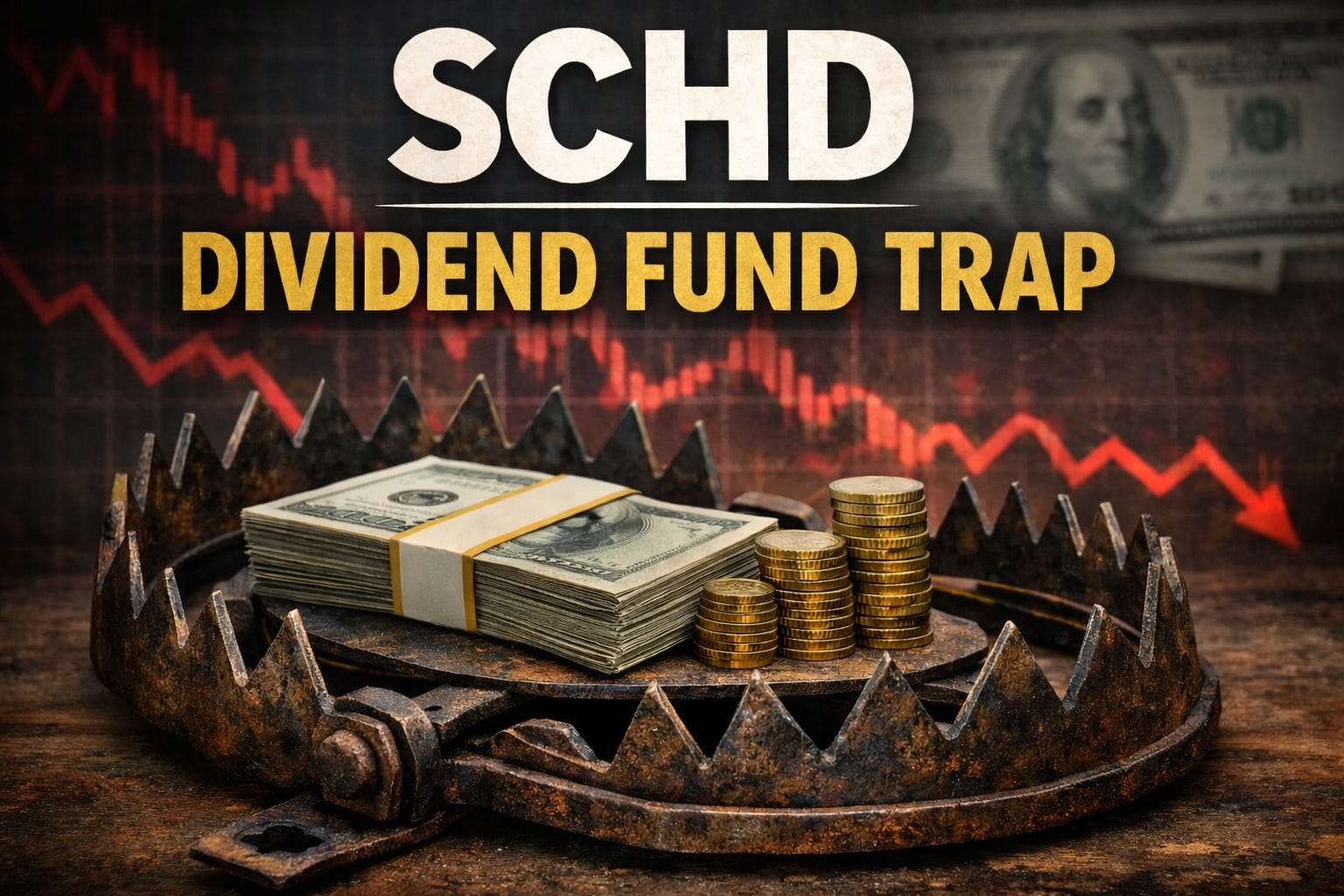
SCHD: A great income fund — but at the wrong price, it can still go nowhere

People don’t buy SCHD because they’re greedy.
They buy it because they’re tired.
Tired of volatility.
Tired of drawdowns.
Tired of feeling like every position is one bad headline away from pain.
That instinct is understandable.
It’s also exactly when most investors quietly overpay for “safety.”
The most expensive time to buy safety
is right after everyone decides they need it.
SCHD is a legitimate income fund. It does what it’s supposed to do.
But good fund and good entry are not the same thing — and confusing the two is how you end up with years of dead money while telling yourself you’re being responsible.
FOR income investors who want a smoother ride than the S&P, a real yield, and companies that can keep paying through ugly cycles.
NOT FOR anyone looking for a quick win, a rerate, or a “safe” trade that magically keeps going up after it gets popular.
HORIZON 12–36 months. You’re buying a cash-flow machine, not a story.
POSITION Hold/Watch. Start small only if price gives you an entry.
DATA AS OF late February 2026.
The Tension
SCHD is what people buy when they’re tired of getting punched in the face by volatility. That’s understandable. It’s also exactly when they tend to overpay.
“Quality” is not a free lunch. When a fund becomes the default safe choice, forward returns compress. You can still collect income, but price appreciation becomes optional — and often absent.
The most expensive time to buy “safety” is right after everyone decides they need it.
The Quality Edge (Yes, It’s Real)
SCHD isn’t a dividend junk drawer. The index forces a quality filter: long dividend history, profitability, cash flow, and balance-sheet discipline. That’s why SCHD generally owns companies that can keep paying even when the economy gets weird.
Sector exposure has leaned into the parts of the market that usually behave like adults — staples, healthcare, industrials — and, recently, more energy than normal. That mix tends to help when growth rolls over and people remember cash flow matters.
The yield is the point. It’s meaningfully above the broad market, and over time the dividend stream has grown at a respectable pace. If you reinvest, the compounding works even when the price does nothing.
Fees are near zero. That matters more than people admit. Over years, low friction beats cleverness.
SCHD’s job is not to impress you.
It’s to keep paying you when other stuff gets cut in half.
Valuation Gravity (Where People Get Cute)
Here’s the part most dividend commentary avoids: a “great” dividend ETF can still be a mediocre buy if you show up late.
On a blended basis, SCHD screens around a high-teens forward multiple. That’s cheaper than the S&P, but it’s not “cheap.” It’s priced like the market already believes the pitch: durable dividends, stable earnings, lower volatility.
That’s fine — until you realize what you’re not buying.
You’re not buying a misunderstood asset. You’re buying something that has already been widely bid up as the safe alternative. When flows do part of the lifting, your margin of safety shrinks.
And then there’s opportunity cost. When growth leads, SCHD can feel like watching paint dry. That’s not a defect. It’s the trade. But don’t pretend you’re buying it for upside and then get mad when it behaves like a dividend fund.
March reconstitution matters because it can change the support beams. If energy gets trimmed and the fund leans more into financials and healthcare, the yield tailwind can soften and rate sensitivity can rise. Longer term it may improve balance. Near term it can be a headwind.
After a run, the usual downside isn’t “crash.”
It’s flatline.
What’s Priced In vs. What’s Not
Priced in:
Dividend durability. Balance-sheet strength. Modest growth. Buybacks. A smoother ride than the market.
Not priced in:
Anything that would make this exciting.
A clean, sustained rate-cut cycle.
A prolonged value regime.
A meaningful reacceleration in dividend growth.
Multiple expansion is not the base case. If it’s part of your thesis, you’re gambling with the wrong instrument.
This is the asymmetry:
SCHD can work perfectly while the price goes nowhere.
You’re not buying an upside catalyst.
You’re buying a paycheck.
The Real Risk: Dead Money
The risk isn’t dividend cuts.
The risk is overconfidence.
SCHD looks most attractive right after it’s already done well — when people are emotionally done with volatility and want something that feels responsible. That’s when they buy “quality” at a price that quietly caps returns.
If you can live with years where the payoff is mostly income, you’re fine.
If you need the price to move, you’ll get frustrated — and then you’ll do something stupid, like sell the dividend fund at the wrong time and chase the next shiny thing.
The market doesn’t punish conservatism.
It punishes being late.
Bottom Line
SCHD is a legitimate core income holding. It’s built to pay you, damp volatility, and keep you invested through messy cycles.
But don’t confuse good fund with good entry.
After a strong run, the right posture is patience and sizing discipline. If you’re buying now, you’re buying income and stability — period. If you want excitement, go elsewhere.
SCHD belongs in a portfolio.
It does not belong at any price.
Playbook
I’m not chasing SCHD up here.
If you buy at these levels, you’re buying the paycheck and the lower volatility — period. I’d only add on a meaningful pullback (when safety isn’t crowded) or if macro clearly shifts in a way that extends the dividend/value bid.
If neither happens, expect exactly what the setup implies: steady income, capped upside, and long stretches where the price does nothing.
Disclaimer:
This publication reflects my personal research, opinions, and investment process. It is provided for informational and educational purposes only and should not be considered financial, investment, tax, or legal advice. Nothing here constitutes a recommendation to buy, sell, or hold any security.
Investing involves risk, including the possible loss of principal. Readers should conduct their own research and consult a qualified professional before making any investment decisions.
I may hold positions in securities mentioned and may buy, sell, or change positions at any time without notice.
“Value SaaS” is only real if the market is pricing in more damage than the business will actually take.
That is the line.
Multiple compression is not the same thing as collapse.
Principle: the opportunity is not in perfect software—it is in overstated decay.