
The Market Is Not a Truth Machine
Prices do not reveal certainty. They reprice probabilities.

Most investors think markets move based on certainty.
They do not.
Markets move based on changing probabilities.
That distinction matters more than most people realize.
Because investors often wait for clarity before they feel comfortable making decisions.
The market usually moves long before clarity arrives.
That is why stocks can rally while headlines still look terrible.
Why markets can fall during “good news.”
Why prices can move violently even when nobody actually knows the final outcome yet.
Markets are not trying to determine truth in real time.
They are constantly repricing odds.
Investors Want Closure. Markets Price Probabilities.
Most investors say they understand probabilities.
Intellectually, many do.
Emotionally, many still treat uncertainty as a temporary condition that enough information should eventually eliminate.
Markets do not work that way.
Uncertainty is not a bug inside financial systems.
It is the system itself.
That is the psychological mismatch.
Human beings want closure.
Markets price uncertainty before closure arrives.
That is why investing often feels frustrating.
The investor keeps waiting for the story to resolve.
The market keeps moving while the story is still unfinished.
The Market Is Not Asking the Same Question You Are
A lot of investing frustration comes from expecting markets to behave like objective scoring systems.
Good news should send stocks higher.
Bad news should send them lower.
Strong companies should outperform weak ones.
But markets rarely work that cleanly.
Because prices do not reflect certainty.
They reflect shifting expectations about uncertain futures.
That means a stock can rise even when conditions still look bad if investors start believing the future may become less bad than expected.
And a stock can fall after strong results if investors realize the future may not improve as much as they hoped.
The market is constantly asking:
“What changed relative to expectations?”
Not:
“Is this objectively good or bad?”
That is why many investors feel confused by market reactions.
They are evaluating headlines.
The market is evaluating probability distributions.
Markets Usually Move Before People Feel Emotionally Safe
This is one of the hardest things for investors to internalize emotionally.
Markets usually bottom before economic pain disappears.
They usually recover before headlines improve.
And they often rally while uncertainty still feels emotionally unbearable.
That feels irrational to many investors.
But it is completely consistent with probabilistic pricing.
By the time the economy looks obviously healthy again, markets usually stopped offering the largest discounts months earlier.
Markets are forward-looking discounting systems.
They are constantly trying to estimate what conditions may look like in the future, not simply react to what feels true today.
That creates enormous psychological friction.
Because human beings naturally want emotional confirmation before they feel comfortable taking risk.
Markets usually move before emotional comfort arrives.
Volatility Is What Unresolved Probability Looks Like
If markets were truth machines, prices would move only when facts became certain.
But that is not how prices behave.
Prices move whenever probabilities change.
Sometimes slightly.
Sometimes violently.
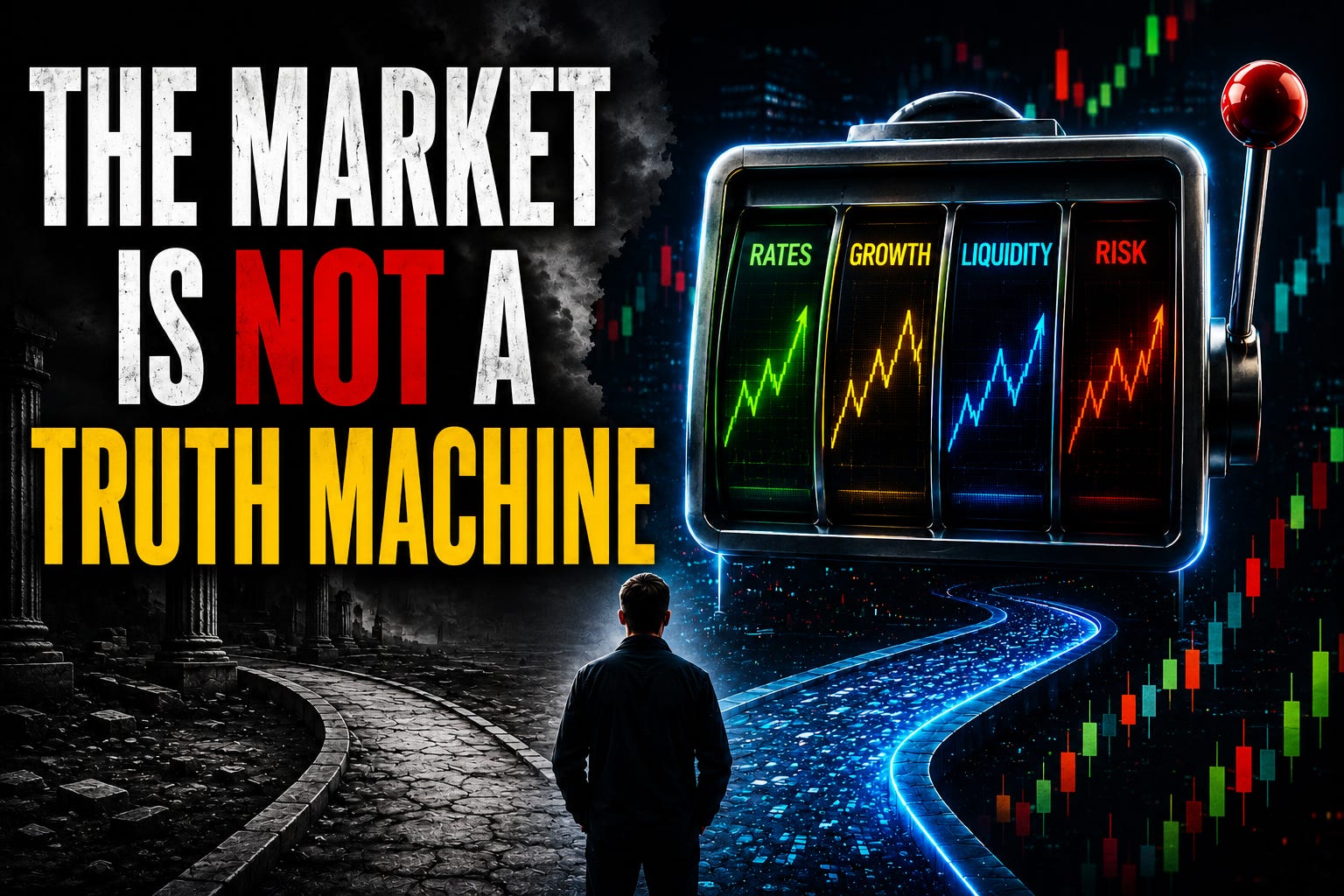
Markets are constantly repricing:
growth expectations
interest rates
margins
liquidity
positioning
future cash flows
risk premia
discount rates
A small change in any of those inputs can create a large move in price.
The price is not saying:
“We know what will happen.”
It is saying:
“The odds may have changed.”
That is a completely different idea.
And it explains why volatility often increases during periods of uncertainty rather than after uncertainty resolves.
Volatility is not always proof that the market is broken.
Sometimes it is simply what unresolved probability looks like in public.
Why Investors Misread Price
One of the biggest investing mistakes is confusing price movement with certainty.
A rising stock does not prove the thesis is correct.
A falling stock does not prove the thesis is broken.
Markets constantly overshoot because investors emotionally overreact to changing probabilities.
Fear exaggerates downside certainty.
Euphoria exaggerates upside certainty.
Both eventually distort pricing.
That is why markets can move far beyond what later reality justifies in either direction.
Not because investors are stupid.
Because uncertainty creates emotional pressure, and emotional pressure changes behavior.
The market does not punish investors for being uncertain.
It often punishes them for needing certainty too badly.
The Real Edge
A lot of investors think edge comes from knowing more.
Sometimes it does.
But many long-term advantages come from accepting something emotionally difficult:
The market does not wait for certainty.
And investors who emotionally require certainty often arrive after the probabilities already changed.
Most investors spend years trying to turn probabilities into certainty.
Markets never really allow it.
The investors who survive are usually the ones who stop emotionally needing them to.
Disclaimer
Phaetrix publishes research, analysis, and market commentary based on a personal investment process.
Nothing here is financial, investment, tax, or legal advice. Nothing presented is a recommendation to buy, sell, or hold any security.
The content reflects how decisions are analyzed, including what could prove a thesis wrong.
Markets move quickly. Setups fail. Losses, including permanent loss of capital, are possible.
Past performance and historical examples are not guarantees of future results.
Positions and views may change without notice as new information becomes available.
All content is provided for informational and educational purposes only.
Investors are responsible for their own decisions, research, and risk management.
Protect capital first.