

One year ago I hit publish on my first Substack post.
I thought I knew what would happen next.
Not the exact subscriber count. Not how fast it would grow. But I thought I understood the formula.
Write useful things.
Improve over time.
Stay consistent.
Let compounding do the rest.
After all, that’s how I’ve spent years thinking about investing.
Do the work. Make good decisions. Be patient.
Eventually the results show up.
What I didn’t understand was how different it feels when you’re the asset.
Staring at the Dashboard
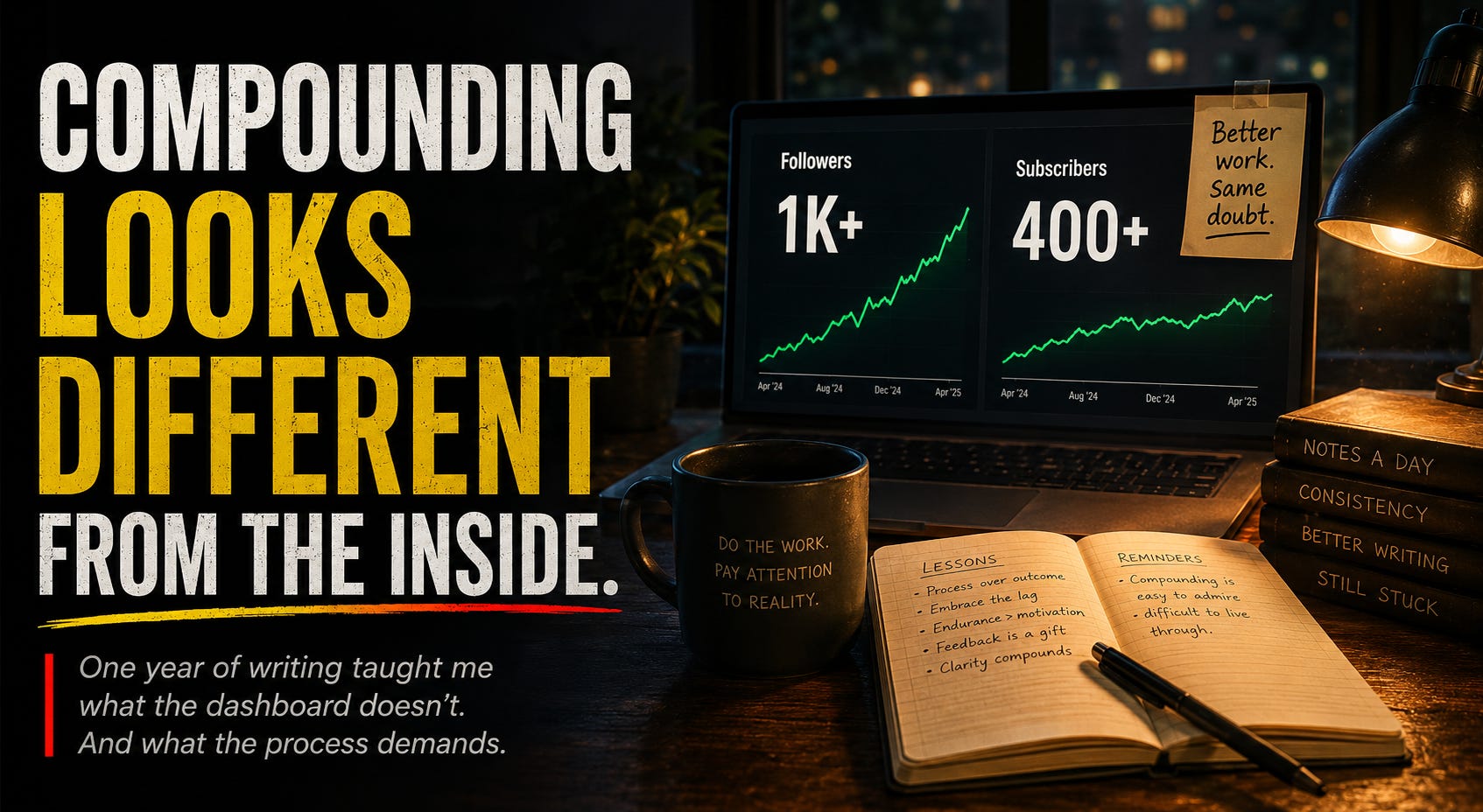
A few months ago I found myself staring at my dashboard again.
Three hundred-something subscribers.
Hundreds of notes.
Dozens of articles.
Thousands of hours reading, researching, writing, editing, rewriting.
And yet the numbers barely seemed to move.
Not literally. They moved.
Just not at the speed I had quietly convinced myself they should.
It wasn’t failure.
It wasn’t success either.
It was a long stretch of reality refusing to cooperate with the story I had written in advance.
So I started looking for explanations.
Maybe I needed more reach.
Maybe I wasn’t posting enough.
Maybe I was posting too much.
Maybe the algorithm had changed.
Maybe the timing was wrong.
Maybe everyone else had figured out something I hadn’t.
Most of those explanations contained a grain of truth.
The problem was that they were also convenient.
Investors do this constantly.
A stock declines and we blame sentiment.
A thesis disappoints and we blame timing.
A position goes nowhere and we explain why the market just hasn’t figured it out yet.
Sometimes those explanations are correct.
Sometimes they’re simply more comfortable than the alternatives.
The Explanation I Was Avoiding
The alternative I spent most of the year avoiding was straightforward:
What if the market was giving me feedback?
Not on whether I was smart.
Not on whether I worked hard.
On whether the work was valuable enough to earn a place in someone else’s limited attention.
That possibility bothered me more than I expected.
Because effort is easy to measure.
Hours are easy to count.
Publishing is easy to see.
Value is harder.
A reader can enjoy a post and never come back.
They can agree with every word and still decide they don’t need more of it.
There is no scoreboard that tells you exactly why someone subscribes, ignores you, shares your work, or leaves.
You just keep publishing and wait for reality to vote.
The uncomfortable part is that reality rarely explains its reasoning.
Meanwhile, something strange happened.
The writing got better.
I can see it clearly now.
The arguments became tighter.
The analysis improved.
The structure improved.
The ideas became more focused.
I became a better writer. I just didn’t become a larger publication at the same pace.
For a while that felt unfair.
Then it occurred to me that I was making the same mistake investors make all the time: treating outcomes as proof.
Good outcome, good process.
Bad outcome, bad process.
Flat outcome, no progress.
Markets punish that kind of thinking.
So does writing.
A good decision can produce a disappointing result.
A bad decision can produce a wonderful result.
And meaningful progress can remain invisible far longer than we want.
What the Year Actually Taught Me
For most of the year I called this patience.
I don’t think that’s quite right anymore.
Patience implies certainty. You believe the outcome is coming and you’re simply waiting for it to arrive.
This felt different.
The evidence was incomplete.
The feedback was mixed.
The scoreboard wasn’t validating the effort.
And I kept going anyway.
That’s where most people leave.
Not because they’re incapable.
Because uncertainty is exhausting.
Looking back, that’s probably the biggest thing Substack taught me this year.
Not writing.
Not growth.
Not distribution.
Endurance.
Most things worth doing spend a surprisingly long time looking indistinguishable from failure.
Businesses do.
Investments do.
Writing apparently does too.
A year ago I thought this project would teach me more about markets.
Instead it taught me something markets have been trying to teach investors forever:
Compounding is easy to admire and difficult to live through.
Especially when you can’t see it happening.
Year Two
So that’s where I am after one year.
Still writing.
Still learning.
Still changing my mind.
Still trying to earn the next subscriber instead of counting the last one.
The plan for year two is the same as it was for year one.
Do the work.
Pay attention to reality.
And when reality disagrees with me, listen.
Because after a year of writing, that’s the lesson I trust most.
Why Subscribe?
Most readers see the research after the thesis is written.
Subscribers also see what the market is offering now.
Phaetrix Daily scans the market for the opportunities that have not yet become obvious — the stocks becoming actionable, the setups quietly improving, and the names where the right decision is still to wait.
Every scan starts with the same question:
Is there anything worth doing today?
Sometimes the answer is yes.
Often, it is not.
Knowing the difference is the point.
Subscribers get access to the market state, actionable setups, developing opportunities, and the names the scanner says not to chase.
The public research explains how I think.
Phaetrix Daily shows where that process is finding opportunity in real time.
By the time an idea becomes obvious, the best part of the setup may already be gone.
Subscribers see what is developing before it becomes the next article.
Subscribe to get Phaetrix Daily and the full Phaetrix research process.
Disclosure & Disclaimer
Phaetrix publishes research, analysis, and market commentary based on my personal investment process.
This site is not financial, investment, tax, or legal advice. I am not acting as your advisor, and nothing here is a recommendation to buy, sell, or hold any security.
The content reflects how I think through decisions — including what I’m watching, what I believe, and what could prove a thesis wrong.
I can be wrong. Setups can fail. Markets can move quickly.
Losses — including permanent loss of capital — are possible.
Past performance, historical analysis, and examples are not guarantees of future results.
I may hold, have held, or trade securities mentioned on this site at any time without notice. Positions and views may change as new information becomes available.
All content is provided for informational and educational purposes only.
You are responsible for your own research, decisions, and outcomes.
If you act on anything presented here, you do so at your own risk.
Invest carefully. Protect capital first.